Thursday, November 30, 2006

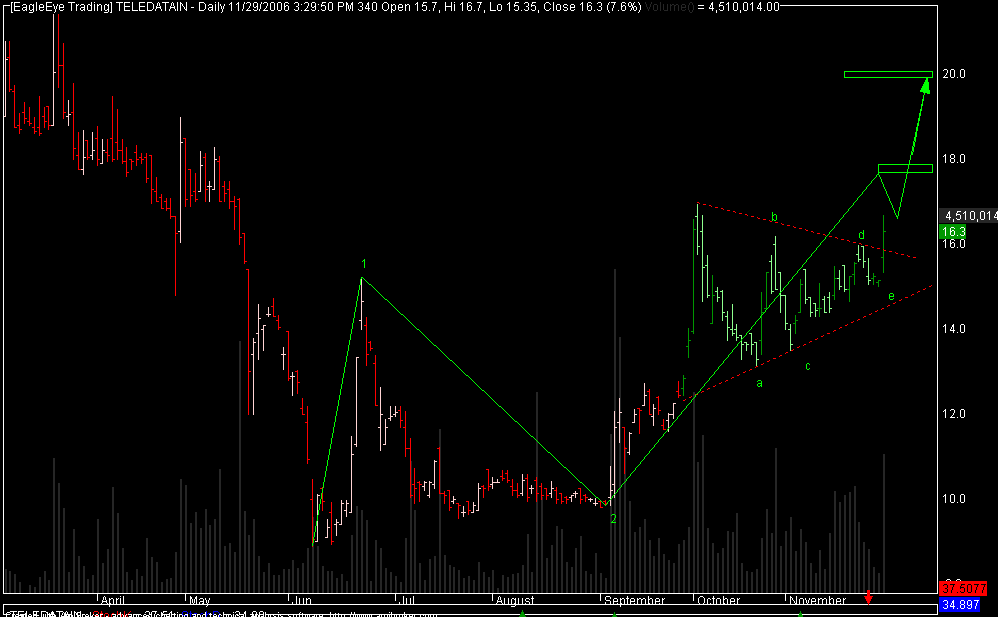
TELE DATA IN


TELE DATA trading in 3rd wave and broke out from a third wave triangle this can be longed with a sl 15.55 for a target of 17+ and then 20+ in coming days
cheers
rish
Wednesday, November 29, 2006

EAGLE EYE TRADING CONSULTANCY

Hello Dear Reader,
Welcome & many thanks to you for reading this site.

Over last few days, many of you inquired (messaged/mailed) about my EagleEye Trading Consultancy service.
I though I would write in detail to make it clear and to show how you all can benefit from this.

EagleEye Trading Consultancy
We strive to achieve Consistent Trading Returns for our Clients while exposing them to Low Risk trades. We have achieved good success in past and strive hard to do so in future.

We strive hard to find big breakouts and large reversals. This are places where most money is made.

I hope, you must have benefited in past with the free calls I have put on this blog. (browse the archives)

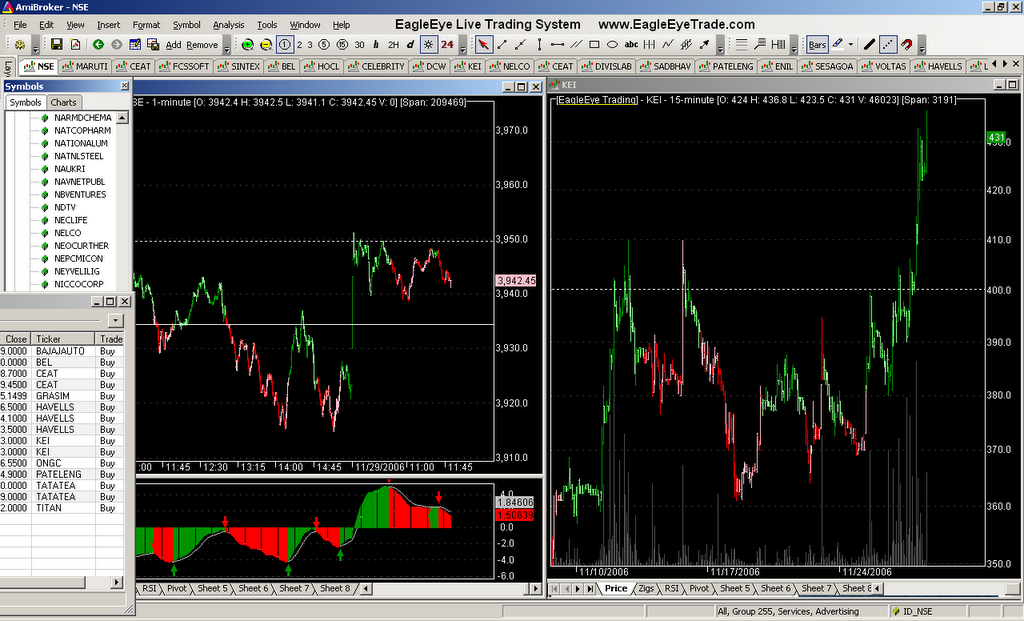
Also open the image below, to have a peek into our trading system. (open the image below and enlarge it.)


This is a snapshot of our trading system, which we follow and enhance religiously to find the next big thing. :-)

(Right click and "Open in new window" and then enlarge)


The consultancy we provide is a paid service.
To know more details about our Trading Consultancy
email: eagleeyetrade@gmail.com
yahoo chat id: rohit_mankotia@yahoo.co.in

TradeWell
Rohit Mankotia
www.EagleEyeTrade.com

India's Economy Probably Expanded Fastest After China

India's economy probably grew at the second-fastest pace among the world's biggest nations last quarter, adding pressure on the central bank to increase borrowing costs for the fourth time in a year.

Asia's fourth-largest economy grew 8.9 percent in the three months to Sept. 30 from a year earlier, matching the gain of the previous quarter, according to the median forecast of 17 economists in a Bloomberg News survey. The statistics department report is due tomorrow at noon in New Delhi.

Consumers in India are using their rising incomes to buy more cars, clothes, mobile phones and houses. That's stretching the production capacity of companies and fanning inflation, and may prompt the Reserve Bank of India to increase interest rates in its next monetary policy statement on Jan. 30.

``Inflation pressures are serious,'' said Rajat Nag, Managing Director General of the Southeast Asia department at the Asian Development Bank in Manila. ``Production capacities must be increased to prevent prices from rising. Interest rates may rise in the short term.''

India's benchmark wholesale price inflation rate held at 5.29 percent in the second week of November, above the government's ``tolerance'' level of 4 percent. Manufacturing inflation rose to 4.59 percent, the highest in 1 1/2 years, as companies including Hindustan Lever Ltd., India's biggest household products maker, raised prices of soap and toothpaste.

Chasing China

India's $775 billion economy has grown more than 8 percent in five of the past six quarters. China's $2.2 trillion economy, Asia's second largest, expanded 10.4 percent in the quarter ended Sept. 30, the quickest pace among the world's 20 largest economies and almost four times the 2.6 percent gain in the 12 European nations sharing the euro.

Reserve Bank of India Governor Yaga Venugopal Reddy in his last monetary policy statement on Oct. 31 said demand pressures exist in the economy and that production capacity must match economic expansion to prevent inflation flaring up.

Reddy and his fellow policy makers are expected to raise interest rates again at the beginning of 2007 as signs of ``overheating'' in the economy have emerged, the Paris-based Organization for Economic Co-operation and Development said in a report yesterday.

General Motors Corp., Royal Dutch Shell Plc. and other companies have invested in about 3,000 new factories and expansion projects worth about $21 billion in India since May 2004 to cater to growing demand, according to Finance Minister Palaniappan Chidambaram.

`Get Stronger'

``India's high growth trajectory is here to stay,'' said Brijmohan Lall Munjal, chairman of Hero Honda Motors Ltd., India's biggest motorcycle maker, currently building its third factory for $420 million. ``Incomes are rising, the government is spending more money to improve infrastructure. Economic growth will only get stronger from here.''

Per-capita income in India has doubled in the last nine years and the number of households earning an annual income of at least $10,000 is rising more than 20 percent a year, according to McKinsey & Co.

The creation of new jobs in the software industry and at call centers is putting more money in the hands of some 350 million middle-class Indians. For example, Dell Inc., the world's second-largest personal-computer maker, opened its fourth customer-service center in India this month as it seeks to reduce costs to shore up declining profit.

Cars, Mobile Phones

Agriculture production rose at the fastest pace in two years in the year ended March 31, increasing incomes of 650 million people who depend on farming for their livelihood.

That's helped companies such as Maruti Udyog Ltd., which sells half the cars bought in India, post a 40 percent gain in fiscal second-quarter profit as it sold more of its new WagonR and Swift hatchback models.

Bharti Airtel Ltd., India's largest mobile-phone service provider, said second-quarter profit soared 79 percent to a record because of a near-doubling of subscribers. India is the fastest-growing cellphone market in the world and companies added a record 6.71 million users last month compared with 6.07 million new users in September.

Growth in India's economy is also benefiting from Prime Minister Manmohan Singh's decision to increase spending on roads, ports and other infrastructure by a quarter to 992 billion rupees ($22 billion) in the year that started April 1 in a bid to attract overseas manufacturing companies and spur growth to 10 percent over a decade.

Public Works

Infrastructure spending is spurring demand for steel, cement and electricity in India, which spends a seventh of China's $150 billion investment in public works each year according to Morgan Stanley.

Governor Reddy last month left the central bank's reverse repurchase rate, or the overnight borrowing rate, unchanged while increasing the repurchase rate, or the overnight lending rate, by a quarter point to 7.25 percent, to give itself room to take further action to prevent ``overheating''.

The Reserve Bank of India, which for the first time said the economy is at risk of ``overheating,'' is reluctant to raise both the interest rates at its disposal at once to avoid slowing the economy too much.

``India can't afford to slow down its pace of growth,'' said Adi Godrej, chairman and managing director, Godrej Consumer Products Ltd., an Indian maker of personal-care items. ``India needs to grow faster to pull out large part of the population which is still reeling under poverty.''

Table of forecasts


-----------------------------------
GDP YoY
Firm Jul-Sep
-----------------------------------
Median 8.9%
Average 8.8%
High 9.7%
Low 7.5%
Number of Forecasts 17
-----------------------------------
Anand Rathi Securities 9.4%
Citigroup 8.5%
Credit Suisse 9.7%
Darashaw & Co. Ltd. 9.1%
DBS Group 8.4%
Deutsche Bank 8.3%
Forecast Singapore 7.5%
Global Absolute Research 9.1%
HSBC 9.0%
ICRA Limited 8.8%
IDBI Capital 8.5%
Ideaglobal 9.0%
ING Vysya Bank 8.9%
JPMorgan Chase 8.7%
Kotak Mahindra Bank 8.9%
Standard Chartered Bank 8.1%
Thomson IFR 9.6%
-----------------------------------
source :- bloomberg

Tuesday, November 28, 2006

Hilton, DLF to Build 75 Hotels in India in 7 Years

Hilton Hotels Corp., the second- largest U.S. provider of rooms, plans to build 75 hotels and serviced apartments in India in a venture with DLF Ltd, a real estate company owned by billionaire Kushal Pal Singh.

Hilton, based in Beverly Hills, California, will invest $143 million building the properties over seven years, the companies said in a statement. DLF will control 74 percent of the venture.

Hilton and Accor SA, Europe's largest hotel company, are building rooms in India as Deccan Aviation Ltd. adds flights to new airports and tourism grows at the world's third-fastest pace after Montenegro and China.

Hilton Chief Executive Officer Stephen Bollenbach said in October the group is also looking for a partner in China, where it plans to open 100 hotels in the next three to five years.

Hilton today said it will build its Hilton Hotels and Hilton Garden Inn brand in India, a move made possible by its $5.7 billion purchase of U.K.-based Hilton Group. The venture will initially build 20 hotels in cities including Chandigarh, Chennai, and Kolkata to cater to business travelers, it said.

Paris-based Accor yesterday said it formed a venture with the Indian unit of Emaar Properties PJSC to set up 100 budget hotels in India. John Keells Holdings Ltd., Sri Lanka's biggest hotel operator, plans to invest $100 million building its first resorts in India, Deputy Chairman Ajit Gunewardene said in an interview in Singapore.
SOURCE:- Bloomberg

NIFTY INTRADAY

Sunday, November 26, 2006

Indian mkt most volatile; but investors happy


It pays to take risk -- even in stock markets. Indian stocks might be the most volatile in the world, but returns for investors are also best among all the leading markets globally, including the US, UK and a number of Asian and European countries.

According to an analysis of the daily return and volatility in benchmark indices of major global markets over the past one year, investors on the Dalal street have reaped highest returns as compared to their global peers.
The Indian market has given a higher return than most of its counterparts despite an equally high level of fear factor -- as measured by volatility in daily market movements.

The Bombay Stock Exchange's 30-share benchmark index Sensex has given an average daily return of around 0.2 per cent over the past one year, which is twice the return given by its closest rival, the South African index.

All other major world stock indices including the US, UK, France, Hong Kong, Singapore, Australia, Malaysia, Mexico and Japan have given a daily average return of below 0.1 per cent.

Notwithstanding the high level of gains from the market, Indian investors are still the most worried lot as the volatility ratio of key stock index is the highest here.

The good news is daily average volatility has been on a gradual decline over the past few months after surging to as high as 3.25 per cent in June this year. It has been hovering around one per cent level over the past couple of months, except for a few days when it went up to nearly two per cent.

The volatility ratio had surged to an all-time high of 12.55 per cent on May 22 -- the day when Sensex recorded the highest intra-day fall of 1,111 points.

However, the current level of volatility in the Indian market is still higher than all the other major markets. Other than India, only Mexico, Brazil, Japan and South Africa have recorded an average daily volatility of more than one per cent over the past one year.

The volatility gauge has been below one per cent in relatively mature markets like the US, UK, France, Hong Kong, Singapore, Australia and Malaysia.

An analysis of the volatility index of BSE Sensex during the April-September period in 2006, shows it had peaked in the May-June period with values as high as 2.55 and 3.25. It then declined gradually on the back of strong FII inflows and improving investor sentiments.

Volatility dropped to 1.97 per cent in July and then to 0.67 in August. Since September onwards, it has hovered between 1-1.6 per cent.

"There was a general decline in volatility of major indices in September 2006 over the previous month. However, the Indian indices were comparatively more volatile over the previous month," market regulator SEBI said in its latest monthly report.

But a high level of volatility has not prevented BSE Sensex from outperforming the frontline indices of other major markets such as the USA, UK and Japan. The returns from Indian markets have outperformed other emerging markets of Brazil, Mexico and South Africa.

Saturday, November 25, 2006

GESCO CORP


GESCO trading in 5th wave more precisely 3 of 5th wave buy in dip for targets of 1063, 1129 and then overall target of 1300 stoploss here is a tricky thing there are two swing points depending upon your risk appetite can choose 992 or 940.
cheers
rish

BUY IN DIPS TO BE RISK FREE

Risk Management

Know how to manage the risk taken in stock trading!

There are vast differences between traders that are considered professional or amateur. A professional trader will avidly try to control risks and understand his/her risks on a daily basis. A professional trader will always be mindful of risk management before, during and after all trading activities. Qualities that make up a particularly good trader involve two key assessments:

* Risk exposure that will come from every stock trade
* Level of risk they are willing to take

Once a good trader has thoroughly these two key items, they will begin to properly understand the value and profit they could make from a particular trade. A trader who is mindful about his or her risk management will evaluate their position or exposure throughout the trade activities, and if the chosen trade carries a high risk, they will cut down on both in order to control risks on the portfolio.

Many traders use a risk management program that is made up various procedures that are implemented to estimate risks. The methods are set up to obtain the best investment results and they include:

* Quantify
* Estimate
* Control Risk

These are all areas of risk management that should be carefully considered, to quantify your risks and performance a financial analysts will apply these concepts and measure:

* Market Beta (linear regression slope of your portfolio or any single stock)
* Correlation (linear regression correlation of your portfolio)
* Volatility (standard deviation of the daily changes in percent of the portfolio price)
* Return and Risk Ratio (higher return or risk ratios mean better performance)

One very popular area of risk management is called the Value at Risk (VAR) concept. Many of the top investment advisors or trading houses use this concept to measure absolute risks of your portfolio. These are measured in dollars per day. In order to properly implement VAR it requires the person to study the price time series on all stocks within a particular portfolio. Many factors go into calculating the VAR concept, factors such as volatility of every stock, correlation among the entire portfolio, and stability of the relationships historically.

Risk management is only successful if the process begins prior to the start of a trade. Single trade risk management is implemented on a per trade basis. You must access many things before you are able to begin this risk management concept.

* First you must know the amount you are willing to lose prior to trading.
* Then you will need to ensure that the stock is active or sufficiently liquid, this is in case you would want to sell or buy promptly.
* Assess the “Cut Loss level” prior to any trading activity.
* Know the take profit level you are targeting.
* Only buy your stock when it as at the acceptable level of pricing.
* After your trade is confirmed, immediately enter a stop loss at market order with your previously determined level.
* Take your profit immediately when it reaches the profit target you determined.

When you manage your risks using the single trade risk management concept, you will find that your entire portfolio risks are under your control as well. Additionally, there are key areas you will want to assess in managing the risks of your portfolio as a whole, as well.

* Prior to building your portfolio, know the overall tolerance of risk
* Assess the overall level of cut loss, in general your portfolio as a whole should not lose in excess of 20% of the capital
* Maintain diversity with your investments, have at least three varied stocks
* Continually practice Single Trade risk management
* Assess the overall risk and the point where the risk comes
* If your risks limits are exceeded you must act quickly
* If your losses meet your overall stop loss level, it is time to close the entire portfolio

Friday, November 24, 2006

INTRADAY NIFTY

HDFC


HDFC is trading in its 5th impulsive wave presently trading in 4 of 5th wave so 5 of 5th is pending can long this with strict sl below 1590 for first target of 1740
cheers
rish

Thursday, November 23, 2006

Apollo Hospitals Plans to Open 500 Indian Drugstores

Apollo Hospitals Enterprise Ltd. plans to open more than two dozen drugstores a month through May 2008 in India, where pharmaceutical sales are growing 10 percent a year.

Apollo, India's biggest health-care company, plans to invest 1.18 billion rupees ($26 million) expanding its chain of pharmacies to 850 from 350 over the next 18 months, K. Padmanabhan, the Chennai-based company's president, said in a telephone interview yesterday.

The company is widening its reach in a country where economic growth and rising household incomes are stoking demand for medicines and health care. Drug sales in India may increase 10 percent this year and next, outpacing global growth of about 7 percent, pharmaceutical research company IMS Health said last month.

Apollo's shares rose 0.2 rupee to end trading at 464.15 rupees on the Bombay Stock Exchange. The stock has declined 7 percent this year.

Apollo also plans to buy more hospitals in the country as the need for medical treatment grows in the world's second-most populated country. It already owns 22 hospitals in India and manages 19 hospitals locally and in countries including Bangladesh and Nigeria.

It's seeking facilities in Mumbai and cities in the Indian states of Uttar Pradesh and Andhra Pradesh, Padmanabhan said.

``We are actively looking at acquisitions of hospitals,'' he said. ``We're looking at valuations.''

Apollo, which hasn't set aside any money for acquisitions so far, has 1 billion rupees in cash available from its sale of securities overseas last year, Padmanabhan said. It would also consider borrowing from banks or the overseas-sale of bonds that can be exchanged for shares to make its purchases, he said.

The company plans to double the number of hospital beds it owns and manages to 14,000 in five years, and is management contracts in the Caribbean including Barbados and the Bahamas.

Microsoft buys 10 per cent stake in TCS China

MUMBAI: Microsoft Co has bought 10 per cent stake in TCS China, a joint venture promoted by India's largest IT services firm Tata Consultancy Services (TCS) and three state-owned Chinese companies.

The US software behemoth on Thursday signed an investment agreement to join the JV, a company release said here. Though the company has not disclosed the investment figures, sources familiar with the development said that Microsoft would pump in $1.4 mil lion for 10 per cent stake in the venture.

With Microsoft's entry, the shareholding of the JV would change. TCS Asia Pacific would now own 65 per cent stake and the Chinese partners 25 per cent, the release said. TCS had last year formed the joint venture with three Chinese companies backed by th e local governments of Beijing and Tianjin.

"TCS China would allow us to provide our clients with the best in technologies at affordable prices, with services delivered at TCS' known global quality processes," Mr Girija Pande, Asia Pacific Head, TCS was quoted as saying.

TCS China would focus on manufacturing, telecom as well as government sectors, it said, adding the company would also concentrate on key technologies with centre of excellence in Microsoft. -PTI

ROLTA


ROLTA trading in 4th of 5th wave and 5th of 5 can start and chart pattern looks like flag pole target of 5th of 5 atleast can be 280can keep sl near yesterdays low
cheers
rish

Wednesday, November 22, 2006

SIEMENS


siemens rockssss.
cheers
rish

Largest contract ever for SIEMENS


Siemens Ltd has announced that a consortium of the Company and Siemens AG, Germany has been awarded a mega contract worth Rs 40,000 million by the Qatar General Electricity and Water Corporation (KAHRAMAA) for development of Phase VII of the Electrical Grid in Qatar. This contract, also the largest ever for the Company, is a repeat order from the same customer. During the last fiscal, Siemens has bagged two contracts amounting to Rs 26,000 million (Rs 2,600 crore) in Qatar. Of these contracts, the Company has already commissioned Phase V and is currently executing Phase VI, which is on schedule.

The scope of the Mega contract is to supply 25 new substations of voltages 220kV/132kV/66kV in addition to extension of 14 substations and renovation of 10 substations. All Substations would be installed with cutting-edge electrical power equipments and Substation Automation systems supplied in-house by Siemens. These stations will be unmanned and controlled by the central load dispatch centre. This order is a fast track project and is slated to be completed in a time span of 22 months.

Mr J Schubert, Managing Director of Siemens Ltd stated, "This export order, the largest in Siemens PTD Worldwide, highlights the inherent strengths and capabilities of Siemens India. Over the years, we have understood our customer's needs, as well as the specific regional requirements. With this approach, we have been able to earn Customer confidence and loyalty, which is strongly backed by the quality and performance of our products and solutions." He also added, "We are once again very happy to partner with Kahramaa in development of Qatar Transmission Network. This win undoubtedly takes us into the global league as a strong and established player in the area of Transmission and Distribution."

Mr Harminder Singh, Director, Siemens Ltd and Head of Power business in India said, "This order, won by the Siemens consortium is a result of intense co-operation between all constituents. While Siemens India, Power Transmission and Distribution Division will play a major role in the execution of the order, we have Specialists and Managers from all over the world working seamlessly together in teams to ensure that project runs completely on schedule, without any compromises. We are very proud that we have been able to bag the biggest order for Siemens PTD worldwide, as well as for Siemens in India. With this mega contract, Siemens continues to maintain its leadership position in the market against some stiff global competition."

Siemens Power Transmission and Distribution Division in India provides products, systems and solutions in the area of medium-voltage and high-voltage switchgear, medium voltage switchboards, high voltage substations, production system, substation automation and power system control and energy management systems.

The Contract Value for Siemens Ltd is Rs 36,000 Million. This order is a fast track project and is slated to be completed in a time span of 22 months.

TATA lands in top 20

Eight Indian business houses have made to the Forbes list of world's most reputed companies, with the country's largest corporate conglomerate Tata group sharing space with the top 20 global firms.
Tatas, the largest Indian group in terms of revenues and market capitalisation, has been ranked at the 20th position among the most reputed company list of Forbes.
Maruti Suzuki, Hero Honda Motors, HLL, ITC, SBI, Infosys and M&M have also managed to find place in the top 200 list.
Italian Food and Tobacco major Barilla Holdings has been ranked at the first position, followed by Denmark's consumer products firm Lego Holdings and German airline Lufthansa at the second and third positions.
Among other Indian companies, Maruti has been ranked at 91st position, Hero Honda Motors at 108th, FMCG major HLL at 116th, ITC and 137th, IT major Infosys at 155th and automotive giant Mahindra & Mahindra has been placed at 189th position.
Tata is the only Indian entity in the top 20 of the list of world's 600 largest companies in terms of corporate reputation.
The Tata group has more than over 90 operating companies, with strong international presence in Automobile, steel, IT and services sectors, with total revenue of $24 billion and a market capitalisation of $47 billion.
courtesy:- economics times

NSE CHANNEL

Tuesday, November 21, 2006

APTECH


APTECH probably a start of fifth wave above 144 will have a smooth ride keep sl at 132
cheers
rish

ARCHIES


archies looks like in a process of completing full cycle 5 impulsive and 3 corrective waves now can keep an eye on red line which will indicate the start of a new wave cycle above 171 it will be good to make a long position in it.
cheers
rish

IPO BULL

MUMBAI: Shares in Internet firm Info Edge (India) Ltd debuted at Rs 491 on the BSE on Tuesday, up 53.4 per cent to the initial public offering (IPO) price of Rs 320 per share. At 2.30 pm, it was quoted even higher at Rs 605 on volumes of 59.54 lakh share s. It touched a high of Rs 605 during the day.

The pricing was at the top end of the indicated Rs 290-Rs 320 price band. The firm's 5.32-million-share offer was bid more than 50 times.

Monday, November 20, 2006

Anil Ambani plans global M&A fund

Anil Ambani is in talks with George Soros, private equity firm Blackstone and Singapore state investment firm Temasek about launching a $5 billion global buyout fund, a paper reported on Monday.

Ambani, one of richest men who controls top CDMA-mobile services provider, Reliance Communications Ltd, has put up $500 million of his personal wealth and has received commitments of up to $2.5 billion from other investors, the Economic Times said.

The fund, which was likely to be based in Singapore, would focus on firms in telecoms, media, communications technology, software, IT-related and broadband services, the paper said, quoting people familiar with the development.

The fund could look for "big-ticket acquisitions" in Asia and the Middle-East, the paper said.

courtesy:- sify finance

Sunday, November 19, 2006

BANK OF INDIA


bank of india bounced from channel top after small consolidation intraday looks quite strong above 197 and can turn weak below 187 upper target comes near 210+ above 197
cheers
rish

ps:-do check market trend before entering the trade

TIGER VS DRAGON


Firms likely to benefit from nuclear deal


The US Senate action put India closer to being able to purchase US nuclear fuel, reactors and related technology.

It has overwhelmingly endorsed a plan to allow US civilian nuclear fuel shipments to India, handing President George W Bush an important victory on one of his top foreign policy initiatives.

Senior lawmakers championed the proposal, which would reverse decades of US anti-proliferation policy.

They said that it strengthens a strategic relationship with a friendly country that has long maintained what the United States considers a responsible nuclear program.

Nuke deal beneficiaries


BHELL&T
Areva T&DNTPC
Reliance EnergyRolta
SiemensABB
Alstom ProjectsCrompton Greaves
HCCGammon


Power generation

Back home, an
alysts have welcomed the Senate approval. "This is a positive development from India's perspective," said Amitabh Chakraborty, Head - PCG, Brics Securities.

The Senate action was critical to help allow India meet its soaring energy needs.

"This is a positive develop
ment for the nuclear power programme in India," said Amitabh Mundhra, Director, Simplex Infrastructure.

The government plans to double the country's power generation capacity that currently stands at 1,250,000 MW.

According to
estimates, India country would need additional 100,000 MW of power by 2012.

"The government has announced its intention and put in more nuclear power. More reactors will be put in place going forward. The deal can give raw material for projects and opens up equipment export avenues," added M V Kotwal, Director, Larsen & Toubro.

Of the total p
ower generated, thermal power constitutes the maximum at 57 per cent followed by hydel power at 25 per cent. Nuclear energy constitutes a meager 3 per cent and this is likely to go up three fold by 2015.

Ashu Kakkar, a technical analyst suggests that potential investors can look into buying L&T, HCC and Gammon India from a long-term perspective.
courtesy:- ndtv profit

Saturday, November 18, 2006

BHARTI YET TO DECIDE BETWEEN WALMART & TESCO

Bharti’s partner for its much awaited retail foray is likely to be finalised shortly. In the face of speculation about its partner - Tesco or Walmart, Bharti Enterprises chairman Sunil Mittal said a final decision has not yet been taken in the matter.
“We are going through the process of finalising the details. No decision has been taken as yet, we are engaged in an inward process that seeks to tie-up all details. We will shortly make an announcement,” Mittal said,

He added details like the size of the investment, the brand name had not been finalised and would happen only after the partner is decided.

It may be recalled that Bharti had been planning an ambitious retail foray, separate from its existing farm produce venture, for over a year now. The company has talked with the likes of Tesco, Walmart and even Carrefour. Till date, Tesco has been seen as the leading contender for partnering Bharti.

Friday, November 17, 2006

nifty intraday 17th nov

US SENATE APPROVES INDIA NUCLEAR DEAL


The US Senate has overwhelmingly voted to pass a controversial deal to share civilian nuclear technology with India.

The deal was proposed over a year ago as a way to boost ties with a strategic ally. In exchange, India must allow the US to inspect its civilian reactors.
Critics have argued the agreement will be detrimental to global anti-nuclear proliferation efforts.But President George W Bush hailed the move as bringing India into the "nuclear non-proliferation mainstream".

"As India's economy continues to grow, this partnership will help India meet its energy needs without increasing air pollution and greenhouse gas emissions," he said.

The legislation was adopted by 85 votes to 12 in the Senate after a series of proposed amendments - which India had opposed - were defeated.The Senate bill and a version passed by the House of Representatives, the lower house of the American parliament, must be reconciled and approved by Mr Bush before the legislation can take effect. Important fillip

The deal is a "lasting incentive" for India not to test nuclear weapons and "to co-operate closely with the United States in stopping proliferation", Senator Richard Lugar said as the upper house of the American parliament began debating the bill. Correspondents say that once the legislation is eventually approved, the initiative will overturn decades of US anti-proliferation policy.

They say that while success for the bill in the Senate hands President George W Bush an important fillip, several obstacles loom before the two countries can begin trade in civilian nuclear materials.

India would need to get approval for the deal from the Nuclear Suppliers Group, an assembly of nations that export nuclear material.Delhi would also need to negotiate a safeguard agreement with the UN nuclear watchdog, the International Atomic Energy Agency.There is also some concern about the transfer of missile technology to Iran by at least two Indian firms, recently black-listed by the US government.

Overwhelming majority

Once those hurdles have been overcome, technical negotiations would need to be completed between the two countries before Congress holds another vote on the overall deal.The BBC's Shahzeb Jillani in Washington says that the Bush administration sees the deal as one of its most important foreign policy initiatives.Overall, the agreement has enjoyed strong bipartisan support among US lawmakers.Earlier this year, the House of Representatives passed its version of the bill with an overwhelming majority.

The Indian Prime Minister, Manmohan Singh, strongly defended the deal in the Indian parliament in August.

He said India would not accept any move by Washington that would impede its atomic weapons programme, nor would it allow any international scrutiny of its military facilities.

But Mr Singh also argued that the deal was in India's interests.
He said mass poverty could only be removed by a fast expanding economy, which in turn needed energy.
courtesy :- BBC NEWS

US SENATE APPROVES INDIA NUCLEAR DEAL


The US Senate has overwhelmingly voted to pass a controversial deal to share civilian nuclear technology with India.

The deal was proposed over a year ago as a way to boost ties with a strategic ally. In exchange, India must allow the US to inspect its civilian reactors.
Critics have argued the agreement will be detrimental to global anti-nuclear proliferation efforts.But President George W Bush hailed the move as bringing India into the "nuclear non-proliferation mainstream".

"As India's economy continues to grow, this partnership will help India meet its energy needs without increasing air pollution and greenhouse gas emissions," he said.

The legislation was adopted by 85 votes to 12 in the Senate after a series of proposed amendments - which India had opposed - were defeated.The Senate bill and a version passed by the House of Representatives, the lower house of the American parliament, must be reconciled and approved by Mr Bush before the legislation can take effect. Important fillip

The deal is a "lasting incentive" for India not to test nuclear weapons and "to co-operate closely with the United States in stopping proliferation", Senator Richard Lugar said as the upper house of the American parliament began debating the bill. Correspondents say that once the legislation is eventually approved, the initiative will overturn decades of US anti-proliferation policy.

They say that while success for the bill in the Senate hands President George W Bush an important fillip, several obstacles loom before the two countries can begin trade in civilian nuclear materials.

India would need to get approval for the deal from the Nuclear Suppliers Group, an assembly of nations that export nuclear material.Delhi would also need to negotiate a safeguard agreement with the UN nuclear watchdog, the International Atomic Energy Agency.There is also some concern about the transfer of missile technology to Iran by at least two Indian firms, recently black-listed by the US government.

Overwhelming majority

Once those hurdles have been overcome, technical negotiations would need to be completed between the two countries before Congress holds another vote on the overall deal.The BBC's Shahzeb Jillani in Washington says that the Bush administration sees the deal as one of its most important foreign policy initiatives.Overall, the agreement has enjoyed strong bipartisan support among US lawmakers.Earlier this year, the House of Representatives passed its version of the bill with an overwhelming majority.

The Indian Prime Minister, Manmohan Singh, strongly defended the deal in the Indian parliament in August.

He said India would not accept any move by Washington that would impede its atomic weapons programme, nor would it allow any international scrutiny of its military facilities.

But Mr Singh also argued that the deal was in India's interests.
He said mass poverty could only be removed by a fast expanding economy, which in turn needed energy.
courtesy :- BBC NEWS

Thursday, November 16, 2006

NIFTY INTRADAY 16TH NOV

acquisitions and orders raining for TCS

Tata Consultancy Services (TCS) has bagged a contract from US-based pharmaceutical company Eli Lilly to provide services in clinical data management, statistical analysis and medical writing for the US firm.According to the release issued by TCS, as per the agreement, the company will also establish a medical information sciences centre in Noida.

"The Lilly-TCS engagement will help us aggressively position as a full services player in the emerging life sciences and healthcare sector," N Chandrasekaran, executive VP, TCS, said Though TCS has not yet disclosed the size of the deal, analysts and investment bankers here said that the contract could be worth $35-40 million.The deal is TCS's second pharma outsourcing contract. Last year, it had bagged a contract from Novo Nordisk for clinical trial data management

Wednesday, November 15, 2006

BL KASHYAP


BL KASHYAP looks to hv finished 3rd wave and presebtly trading in 4th corrective wave a sl near 1300 and buying in dip is reccomended can see sharp rise above slanting dotted line
cheers
rish

Tuesday, November 14, 2006

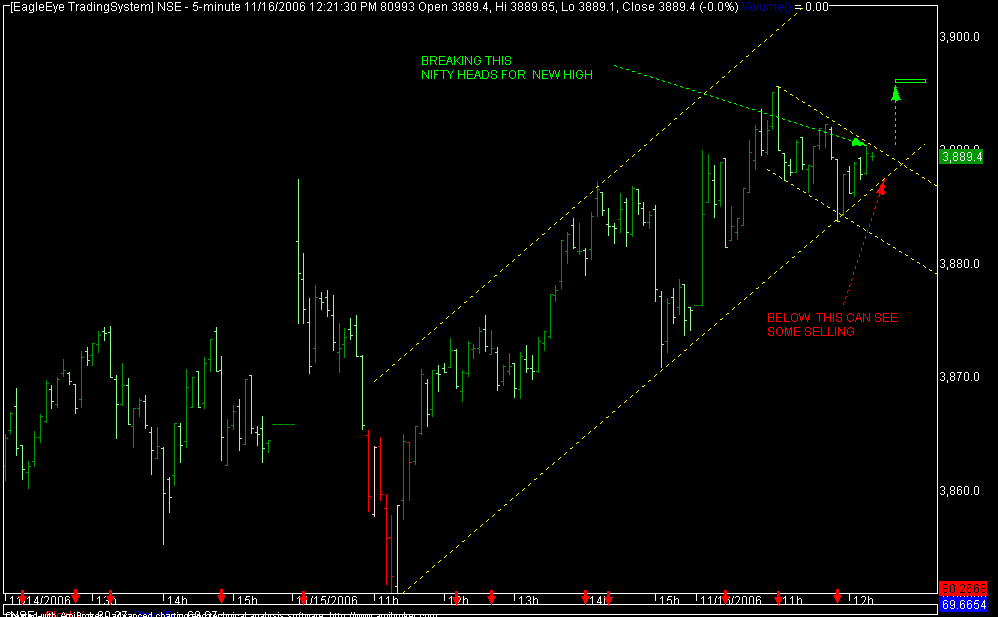
NIFTY INTRADAY


NIFTY third wave going on wait for ABC correction of 4th wave to think of shorting (looks to be near completion 3rd wave )so patience is the buzz word.
cheers
rish

CEAT


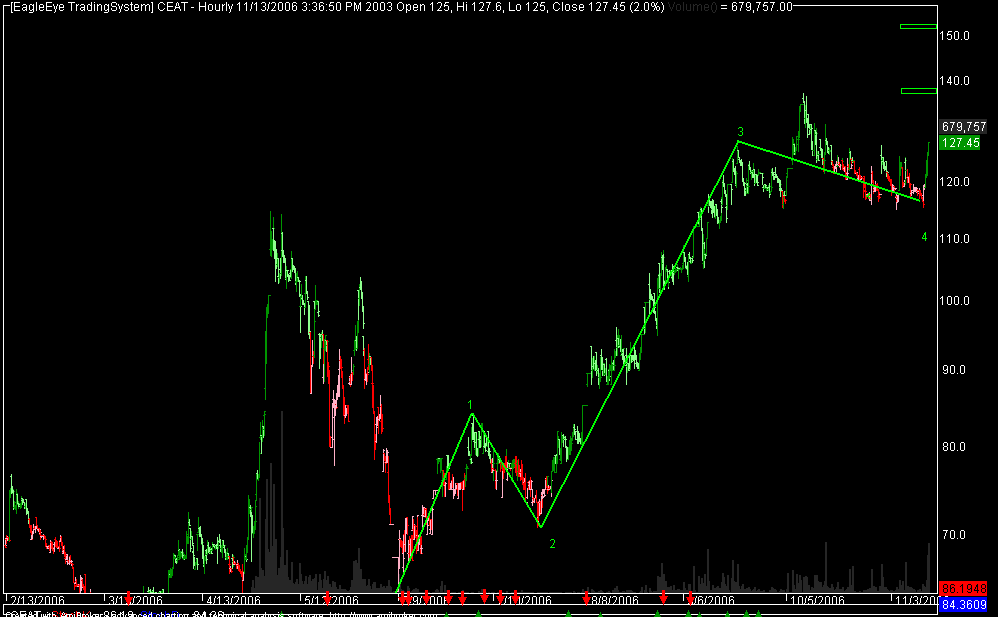
CEAT looks like has finished 4th corrective wave and should start its fifth bullish wave a 2 days close above 130 should signal start of fifth wave so on upside we have targets as 138 and 150+ can be bought in dips .
cheers
rish

Monday, November 13, 2006

alps industries


ALPS INDUSTIES most probably trading in 3rd of 5th wave and we saw today a nice small pennant breakout stock is still a buy in dips for a target of 95-100.
cheers
rish

Saturday, November 11, 2006

ADITYA BIRLA NUVO


ADITYA BIRLA NUVO looks to be trading in 5 of fifth wave it shud hv a minimum target of 1082-1100 and above that 1225 buy in declines for the above target
cheers
rish

India's Sugar Mills Turn to Ethanol to Meet New Rule

Bajaj Hindusthan Ltd., India's biggest sugar maker, and rival mills plan to more than double sales of ethanol to meet government alternative fuel targets, helping boost earnings as prices of the sweetener slump.

The mills will get an extra 12 billion rupees ($263 million) in revenue from ethanol over the next year, S.L. Jain, director general of Indian Sugar Mills Association, said. India passed a law in May requiring gasoline to be mixed with 5 percent ethanol starting this month.

India joins the U.S. and the European Union in increasing ethanol usage following a surge in crude oil prices. Bajaj, one of the world's 10 biggest ethanol makers, is seeking to almost triple biofuel production as raw sugar prices in New York have fallen 41 percent from a 25-year high in February.

``Ethanol will provide constant revenue when sugar prices have declined,'' Anoop Bhaskar, a fund manager at Sundaram BNP Paribas Mutual Fund in Chennai, said yesterday. The fund held 721,374 shares of Bajaj Hindusthan on Sept. 30, according to Bloomberg data. Ethanol in India is made from molasses, a sugar byproduct.

Sugar for March delivery rose 1.84 percent to 12.18 cents a pound on the New York Board of Trade yesterday. Raw sugar was the best performing commodity in 2005. Ethanol prices in the U.S. averaged $2.22 a gallon on Nov. 9. Prices reached a record $4.23 a gallon in June.

Investors including Bill Gates, Richard Branson and Vinod Khosla are pouring millions of dollars into biofuel companies on optimism that use of alternative fuels will gain as energy costs rise and countries tighten pollution control norms.

U.S., Europe

About two-fifths of gasoline sold in the U.S. contains 10 percent ethanol, while the European Union wants every tank of fuel to consist of 5.75 percent biofuels by 2010. A fifth of Brazil's road fuel comes from ethanol and South Africa may order the use of ethanol-blended fuel next year.

Sugar millers will sell oil refiners 550 million liters of the additive at 21.5 rupees a liter, 15 percent more from a year ago, the association's Jain said on Nov. 4. Refiners will start selling blended fuel across India in two weeks, he said.

Bajaj Chief Executive Kushagra Bajaj, 29, has overseen a 15-fold increase in the value of the family controlled company in three years, to almost $1 billion, as sugar prices more than doubled to a record in May.

New Customers

Bajaj, whose 320,000 liters a day capacity will double by September next year, has bid for ``maximum quantity'' needed by refiners, Ravi Gupta, president of the alcohol business, said by e-mail. Ethanol will bring in 22 percent of the company's profit in three years, from 10 percent now, Nomura International said in a report.

``The ethanol program has created a new class of customers for us on a sustained basis,'' said Kishor Shah, chief financial officer at Balrampur Chini Mills Ltd., India's second-biggest sugar maker. The company is raising its ethanol-making capacity by almost half to 320,000 liters a day, he said.

Global ethanol demand will rise 51 percent to 54.5 million tons by 2010, with Asia using 7.5 million tons, four times the current demand, according to Noble Group Ltd.

Indian distilleries can produce up to 1.3 billion liters a year of ethanol suitable for use as fuel, Jain said.

Shares Slump

Bajaj Hindusthan shares have slumped 55 percent since May, while those of Balrampur Chini have halved after sugar prices fell from records on forecasts of bigger harvests in Brazil and India, the world's biggest producers.

Refined sugar for March delivery rose 0.3 percent to $376.2 a ton on London's Euronext.liffe yesterday. White sugar reached a record $497 on May 12.

``Global sugar prices appear to be unsustainably low,'' JPMorgan India Pvt. analysts led by Vijay Chug said in an Oct. 18 report. ``We expect prices to improve by at least 20 to 25 percent over the next six to 12 months.''

Bajaj may say net income climbed 77 percent to 2.48 billion rupees in the year ended Sept. 30 from a year earlier, according to an average estimate by Thomson Financial. Profit may surge to 4.32 billion rupees in the year to Sept. 30, 2007. The company will announce fourth-quarter earnings next month.

India's annual gasoline consumption may rise by more than a third to 12.24 million tons by 2012, fuelled by car sales that are forecast to rise 10 percent annually until 2010, according to the Society of Indian Automobile Manufacturers.

Refiners may require 1.1 billion liters of ethanol starting June 2007 after the government doubles the additive's content to 10 percent, Petroleum Ministry Secretary M.S. Srinivasan said on Nov. 8. That will help expand sales for sugar mills.

``One hopes refiners will increase the blending next year, in which case quantities needed will be much higher,'' Narendra Murkumbi, managing director of Sree Renuka Sugars Ltd., India's third biggest producer by market value, said in Nov. 6 interview.

Sree Renuka's ethanol capacity is being expanded nine-fold to 110 million liters annually by September next year, he said.

To contact the reporter on this story: Pratik Parija in New Delhi at pparija@bloomberg.net .

courtesy:- bloomberg

On Jesse Livermore And His Legacy


I am choosing to write a short biography of Jesse Livermore and his trading philosophies. Livermore was a great trader and speculator – always willing to learn, study and open to new ideas. He was also an eccentric man, unparalleled in his dedication to always gaining an advantage over all other traders and investors. So why Livermore? Is it because of the glamour of discussing such a man? No. Why not Gann? Or Buffet? Was there some type of “secret recipe” for his successes in both the stock and the commodities market?

Definitely not. I am choosing to discuss Livermore because I believe that the legacy left by Livermore is a very important and instructive legacy for the novice, the amateur, and even the professional trader. His teachings all throughout his books and biographies were all about basic trading philosophies such as trend-following, buying and holding in a bull market, industry analyses, following the leaders, identifying pivot points, and of course, risk management. All this did not come easily. It took Livermore literally years to nearly perfect his system and methods, and it requires intensive studying and effort in order to execute and to stay disciplined. This is what Livermore has emphasized all throughout his writings – that the stock market is not for the lazy nor the uninitiated. If one really wants to succeed in making money in the stock market over the long haul, then one will need to put in the necessary time and effort – not only in the studying of the stock market, but in the studying of one's own psychology and tolerances as well.

A more subtle but if not more important question for professional traders to ask is: If Livermore was so great, why did he ultimately lose his fortune again during the Great Depression and why was he not able to make a “comeback” again? This and the fact that Livermore had periodically suffered from depression throughout his life finally led to his suicide in 1940. What went wrong? Traders would often cite his lack of risk management, but I think it goes deeper than that. Perhaps he was getting older and lost his drive, but I believe there is a more important underlying theme and lesson to all this. I will discuss this in later paragraphs.

Early on, Jesse Livermore learned that in order to succeed in life, one needs to put in a great deal of time and effort to an endeavor that one enjoys doing. Of course, it didn't hurt that Livermore also had a great genius with crunching numbers and a great discipline for keeping records. It also didn't hurt in that Livermore was always willing to learn and was always receptive to new ideas. As a young lad, he chose the stock and commodities market as a way to keep score and to make his fortune, and this is what he did until the day that he died.

Livermore was a self-made man. He ran away from home at the age of only 14 and subsequently went to work as a quotation boy in Boston. He quickly learned the art of “reading the tape” and from here, he proceeded to trade in the bucket shops – and was so successful that he was practically banned from trading in all the major bucket shops in Boston. From the bucket shops, he relocated to New York and started trading on the Big Board in the office of E. F. Hutton. This was in the year 1897. By that time, Livermore had already gained a reputation as the “Boy Plunger” in all the bucket shops in Boston. He was only 20 years old.

Trading “legitimately” on the NYSE taught Jesse Livermore his first major lesson in how to consistently make money in the stock market. How? Within six months of opening his account in a legitimate brokerage firm, he had lost all his money – all $2,500 of it – approximately the equivalent of $60,000 in today's dollars. The average person will most probably swear off stock market speculation forever if he was to lose his entire fortune in the endeavor, but not so for Livermore. Of course, he was depressed. Any emotional being would be depressed on losing his entire fortune. But this unfortunate development only motivated Livermore to study his mistakes more carefully. He was able to beat the game in the bucket shops, so why not on the Big Board?

There are many lessons to be learned here. Let's start with the first lesson. Please note that I am not going to list them in any particular order. Each trader/speculator has to deal with their own trading flaws – some lessons may be more applicable than others to one trader but the same lessons may not apply to another type of trader – especially so if he has conquered them.

jesse livermore Jesse Livermore Lesson One
Livermore had no prior trading experience except for his trading experience in the bucket shops. His first mistake was his belief that he could directly apply his prior system of trading to trading in actual stocks on the New York Stock Exchange as well.

What were the differences? Why couldn't he directly apply his system of trading in the bucket shops to trading on the NYSE as well? Livermore studied the differences intently – major money and his future career were at stake here. He learned several things about the art of speculation. Among them were:

The greatest amount of money is made following the major trends – not in the day-to-day fluctuations of a stock or in a particular commodity. This fact was later compounded by his experience during the 1901 bull market. He had always been able to call significant bottoms in the stock market and had always be able to initiate long positions at the most opportune time. And yet, he would always sell his long positions after only making 10% or 20% hoping he will be able to get back in at lower prices. This usually does not happen. He eventually learned that in order to make money in the stock market, one will need to adopt a buy and hold strategy in a bull market and only sell when the bull market is on its last legs.


Livermore had a significant execution disadvantage by taking his actual business to the NYSE. Not only does he have go pay a high commission (compared to virtually none in the bucket shops although he got a severe handicap when he did trade there), there was also a significant delay between the time he places his order to when the order was actually executed. This disadvantage is severely magnified when one traded as often as Livermore did in his early days as a trader on the NYSE. Livermore was handed down the ultimate lesson in the art of execution during the final day of the Northern Pacific Corner on May 9, 1901. Livermore had anticipated a huge downside move in the morning and a subsequent one-day upside reversal. He was right, of course, but he ultimately lost his entire stake of $50,000 that day. Because of the huge volume during that day, the tape was nearly two hours behind; his brokers (who were very able) did place an order to short U.S. Steel and Santa Fe in the morning, but those orders did not get executed until two hours later. By then, both Steel and Santa Fe had already fallen by over two dozen points. When Livermore ultimately covered, he did so at levels that were two dozen points higher. This one-day plunder cost him his entire stake which it took him a long time to build up.

While his tape-reading skills were still important, they were not as important as studying the fundamentals of each company and the credit conditions of the stock market and the economy. His first successful “raid” on the stock market based on his sound, fundamental studies occurred during the Panic of 1907. As credit conditions tightened and as a number of businesses and Wall Street brokerages went bankrupt during the summer, Livermore could sense that something was wrong – despite the hopes of the public as evident in the still-rising stock market. Sooner or later, Livermore concluded, there will be a huge break of epic proportions. Livermore continued to establish his short positions, and by October, the decline of the stock market started accelerating with the collapse of the Knickerbocker Trust in New York City and Westinghouse Electric. J.P. Morgan eventually stepped in to avert the collapse of the banking system and the New York Stock Exchange, but only after Livermore managed to make more than one million dollars by shorting the most popular stocks (and covering on a plea from J.P. Morgan himself) in the stock market.
There are many lessons to be learned here by professional and amateur investors alike. While I have always maintained that the majority of traders and investors in the stock market usually under-perform the stock market, it is doubly true that virtually all traders who focus on the short-term eventually lose their capital. The successful daytraders are a rare breed – and the successful ones can only expect to obtain a return of 10% to 12% a year, at best. The amateur trader who expects a first-year 100% return by daytrading stocks just does not have a chance.

A more subtle lesson to be learned is the idea of evolution – evolving one's style to not only fit one's personality, but evolve to the point so that it will fit the market's personality as well. What made Livermore so successful during the first thirty years of the 20th century was this: Not only was he multi-talented in the traditional sense (his skills in analyzing long-term trends and fundamentals were as good as his skills in tape-reading and in daytrading), he was also multi-talented in the sense that he was able to evolve with the market very successfully. He had always been flexible in either trading the long side or short side – and he was also able to sit out in a market that was devoid of activity as well.
Woopidoo.com

Friday, November 10, 2006

Mercs selling like hot cakes in small towns

INDIA on a roll as economy growing peoples purchasing power too on an exponential growth.Mercedes Benz which was like an dream for many and was owened by super rich only is now can be seen in small towns too, Mercedes Benz luxury sedans are garnering increasing sales from smaller Indian towns, according to DiamlerChrysler.

The company is looking at a hub-and-spoke model to provide its services to these towns through 12 dealers across the country.IN coming years would like to see more of BMW'S & lexus's on INDIAN ROADS ;-).
CHEERS
RISH

NSE INTRADAY

STERLITE


sterlite touched channel resistance(558-560) and came back and is presently hovering around near to support (525-528)so keep an eye on yesterdays high if it trades above it can again try to touch channel resistance else a short opens below support area.
cheers
rish

Thursday, November 09, 2006

sweetness to come back in sugar sector

Food and Agriculture Minister Sharad Pawar today indicated that a decision on lifting the ban on sugar export would be taken in the next two weeks.

“We are seriously considering lifting the sugar export ban in the next two weeks as availability of sugar is not a concern now,” Pawar said.

He also announced slashing of interest rates on loans disbursed from the Sugarcane Development Fund (SDF) as well as on those advanced by banks to cooperative sugar mills covered under the credit restructuring package.

“Since a substantial quantity of sugar would be available in the next season, the ban on export would have to be lifted and a decision would be taken at the appropriate time,” he said at the Economic Editors’ Conference here today. The sugar output this year was expected to rise to around 22.7 million tonnes from last season’s 19 million tonnes.
The area under the sugarcane crop had gone up this year because farmers got the highest-ever prices for their cane last year.
“Though this year they may not get that kind of returns, their realisation will not be below Rs 100 to Rs 120 a quintal,” Pawar said and added that the cane yield was likely to be good this year because of favourable weather conditions.
The minister announced that the rate of interest on all outstanding SDF loans and fresh loans disbursed on or after October 21, 2004, had been reduced to 4 per cent a year (simple interest).
Besides, the normative project cost for SDF funds had also been revised for projects for bagasse-based co-generation of power from Rs 265 lakh per mega watt to Rs 293 lakh for boiler pressure up to 70 per cent atmosphere (1.03 per kg sq cm) and to Rs 363 lakh per MW for over 70 per cent atmosphere.

The SDF loan component had been stepped up from the earlier 30 per cent of co-generation project costs to 40 per cent, he said.For the cooperative sugar mills whose loans had been restructured, Pawar announced a reduction in the rate of interest charged by banks from around 14 per cent a year to 10 per cent. The Centre would reimburse about Rs 560 crore to the concerned banks for this purpose.He claimed that measures taken by the government had helped revive the sugar industry which, in turn, had facilitated timely payment of cane prices to farmers.In 2005-06, about Rs 19,667 crore had been paid by sugar mills as cane prices to farmers. The outstanding payments came to just Rs 177 crore, amounting to below 1 per cent of the total cane price payable during the season.

The recent rollout of the ethanol blending programme by the government should further strengthen the sugar industry, Pawar maintained.India plans to introduce the mandatory blending of 10 per cent ethanol into gasoline across the entire country from June 2007, Petroleum Secretary M S Srinivasan said on Wednesday.

He said the use of 5 per cent ethanol mixed petrol, currently used in three states, is expected to be spread to rest of the country by Nov 15. We have already tied up 50 per cent of the 560 million tonnes of ethanol needed for 5 per cent mixing at Rs 21.50 a litre," Srinivasan said.

India will need 1.12 billion litres of ethanol a year for the move to 10 per cent blended petrol.

"We expect substantial availability of ethanol for 10 per cent blending as new capacities are being created and we are expecting a bumper crop of sugarcane," he said Agriculture Minister, Sharad Pawar, said on Wednesday that sugar production in the cane crushing season that began in October was likely to reach 22.7 million tonnes, up from 19 million tonnes in the year ago period.
Faced with the surge in production a ban on sugar exports may be lifted within the next two weeks, Pawar said.

India also plans to replace around 5 per cent of its current 40 million tonnes of annual diesel consumption with jatropha biodiesel within about five years, as it tries to limit oil imports that account for 70 per cent of its needs
source:- financial express & business standard

Reliance bids for BP plant in Belgium

Reliance Industries is believed to have put in a $2 billion bid for the
refinery and petrochemicals facility of British Petroleum (BP) in Belgium.

Sources familiar with the development said Reliance, which had been in talks
with BP for the Belgium unit for over a year, had recently put in a formal
proposal. The deal might be announced anytime, they added. However, there
was no official confirmation on this from Reliance. When contacted, a
Reliance spokesperson declined to comment.

The sources said Reliance Chairman Mukesh Ambani would discuss
the proposed acquisition of the unit with the Belgian Prime Minister Guy
Verhofstadt who is currently in India on a six-day tour.

This deal will mark the first major acquisition of Reliance Industries,
which generates surplus cash of over Rs 17,000 crore a year, in the
exploration sector. Reliance's networth stands at Rs 54,000 crore.

The Reliance board will meet tomorrow to consider raising $2 billion (nearly
Rs 9,000 crore) to fund investment in oil and gas exploration and production
business. The instrument for the fund raising could be foreign currency
convertible bonds.

Ambani, in a recent media interview, had said the company was eyeing oil
firms in the North Sea and also aimed at acquiring oil drilling and
engineering firm in Africa, South America, the Middle East and India.

He said British companies working in the North Sea would become soft target
with dwindling reserves in the region.
bussiness standard

Wednesday, November 08, 2006

CUMMINS INDIA


CUMMINS INDIA has almost done its expanding triangle target of 284 and we have seen usually expanding triangles occur on tops or bottoms this one looks to be on top so any longs in this should be taken only if you see channel broken with considerable volumes else we see some fall in the script.Trade accordingly.
cheers
rish

NIFTY INTRA

genusovere


GENUSOVERE near breakout can be longed above 242 for first target of 250+
cheers
rish

Tuesday, November 07, 2006

INFOSYS SCALING NEW PEAKS

Infosys chief mentor N R Narayana Murthy on Tuesday said the sponsored secondary ADR issue is part of the company's ambition to get into the NASDAQ-100 Index, raise brand equity in the US and win more customers there.

Responding to questions at an extra-ordinary general meeting in Bngalore, he said: "We want to be the first Indian registered company to get into the NASDAQ index. That particular journey requires that we enhance liquidity in the US. This is part of reaching that goal."

In the lively EGM, where a section of shareholders expressed concern over the ADR issue and wondered whether such exercises are a precursor to the Bangalore-based company being taken over by 'foreigners', Murthy asserted that the aim is to make Infosys bigger.

The special resolution on the ADR issue (not exceeding 30 million shares) was passed with requisite majority; it was not unanimous.

Currently, foreign institutional investors hold 36 per cent stock of Infosys and ADR holders around 14 per cent. As much as 13.95 per cent of the total company stocks are listed and traded outside India.

If the issue -- which is the company's third after the ones in 2003 and 2005 -- is fully subscribed, the figure of 13.95 per cent would go up to 19.35 per cent, Infosys chief
financial officer V Balakrishnan said.
courtesy:-www.rediff.com

TATA STEEL


TATA STEEL came out of down channel can move higher sl can be kept at 499 can target 515 and then 520
cheers
rish

THERMAX


thermax a good breakout should trade consistently above 342 will target 356 ,366
cheers
rish

Sunday, November 05, 2006

INDIA BULLS


INDIA BULLS rising strongly in a channel buy in dips a stop loss can be kept near 440 levels and long it fot targets of 500 and 540 in coming days
cheers
rish

PS::- SL IS MUST KEEPING IN MIND MARKET CONDITION

ONGC may rope in Hindujas for oil hunt

fter tying up with steel tycoon Lakshmi N Mittal, Oil and Natural Gas Corporation (ONGC) is roping in the diversified, multi-billion dollar Hinduja group for acquiring oilfields abroad and sourcing liquefied natural gas.

While ONGC roped in the Mittal group to use its “influence” in African and central Asian countries to acquire oil and gas fields, the state-run firm was tapping the Hindujas to leverage their business relations in oil and gas-rich West Asia, industry sources said.

A formal agreement to float a 51:49 joint venture, similar to ONGC Mittal Energy Ltd formed last year, is likely to be signed this month.
The ONGC-Hinduja venture has identified seven countries — Iran, Qatar, Kuwait, Libya, Oman, Saudi Arabia and the UAE — for acquiring stakes in oil and gas fields and firming up liquefied natural gas supplies.
Though ONGC Mittal Energy Ltd had identified Kazakhstan, Turkmenistan, Azerbaijan, Uzbekistan, Congo, Angola, Trinidad and Tobago, Romania and Indonesia as priority areas for doing business, the joint venture has managed to land two blocks in Nigeria.
Sources said ONGC had last year signed a memorandum of understanding with Ashok Leyland Project Services, a Hinduja group company, to float a 50:50 joint venture to invest in liquefied natural gas terminals with associated power, petrochemicals and gas pipeline grid projects, and related opportunities in southern India.
The agreement called for the Hindujas to play a lead role in importing up to 10 million tonnes of liquefied natural gas a year and jointly set up power plants with a capacity of 1,000-1,800 Mw.
However, the agreement could not be implemented due to objections from government directors on the ONGC board. After much debate and consideration, a fresh agreement had been approved, which would be signed later this month, sources said.
They said ONGC was keen to leverage the clout of the Hindujas in the Persian Gulf, particularly in Iran and Qatar, for sourcing liquefied natural gas for its proposed Rs 25,000 crore Mangalore integrated project.
India has already signed a $22-billion deal with Iran to import 7.5 million tonnes of liquefied natural gas every year from 2010. But Tehran was not honouring its commitment and ONGC felt the Hindujas, who enjoy considerable influence in Iran, could help, sources said.
Previously, the Hindujas had signed an agreement with Indian Oil Corporation for the latter’s proposed liquefied natural gas terminal at Ennore but the project could not take off.
business standard

Friday, November 03, 2006

NAE INTRADAY

MSK PROJECT


MSK PROJECT BOUNCING FROM SUPPORT CAN TAGET 81 AND THN 90

MEDIA VIDEO


MEDIA VIDEO moving in a range keep strict stop loss and long it 38.40
check market direction before taking position in trade
cheers
rish

Wednesday, November 01, 2006

RELIANCE


RELIANCE again showed its might and saved nifty again in the process it gave a breakout from a channel give a day or two to prove that the breakout is genuine volumes were fair if its a valid breakout it can at least target 1300 in coming days sl is way below at 1240.
cheers
rish

zee tele